
Why Won't It Go Away? The Reasons PM2.5 Keeps Rising Every Year — and How to Protect Yourself
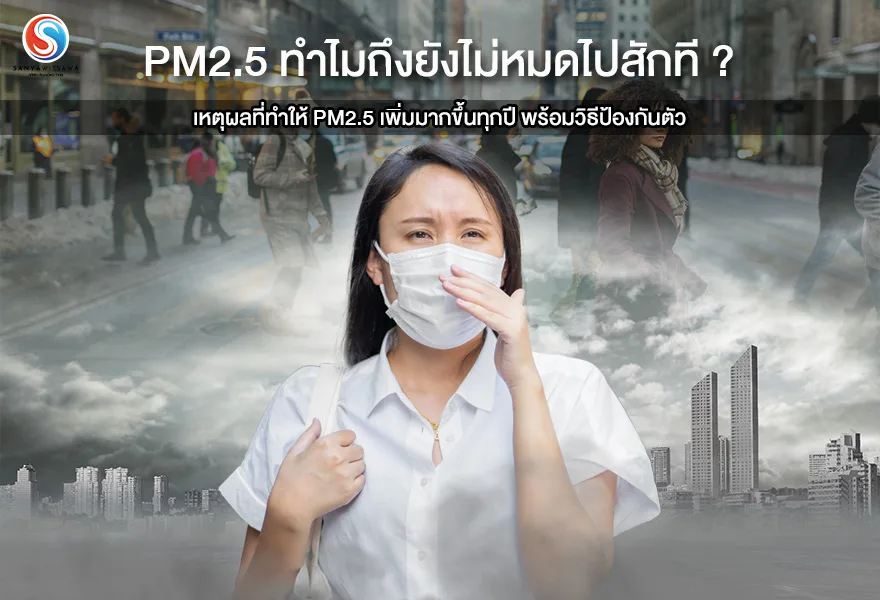
Why won't it go away? For many years now, fine airborne particulate matter — PM2.5 — has been a chronic problem affecting both health and the environment in Thailand. As many people have noticed, particulate levels in Bangkok, Chiang Mai and other major cities exceed safe limits every single year, visibly transforming the landscape: a hazy, murky atmosphere as if fog had rolled in, skies so thick with dust that the clouds all but disappear, and air so polluted you cannot draw a full breath — forcing you to wear a face mask the whole time you are outdoors.
Every year, a great many Thais die because of fine PM2.5 particles. These particles also raise the risk of a wide range of diseases — respiratory illness, skin conditions, heart disease, lung disease, and even the one disease most people dread the most: lung cancer. Because PM2.5 consists of particles smaller than 2.5 microns — roughly 1/25 the diameter of a human hair — it is extremely hazardous to health. It travels easily through the airways into the lungs and the bloodstream, and if inhaled over a long period, these particles accumulate steadily in the body until they become a source of serious illness. Make no mistake — particulate pollution really is no small matter. The longer it is ignored, the more harm it does to our bodies.
So do you want to know why PM2.5 grows worse every year, with no sign whatsoever of declining?
Today, Sanyawit will take you through the answers, along with ways to protect yourself from PM2.5.
PM2.5: how this particulate pollution forms, and why it never seems to subside
The causes behind PM2.5 — fine particles whose danger is anything but small.
Wildfires and forest burning – Although wildfires can occur naturally through lightning, friction between branches, or chemical reactions triggered by sunlight in dry areas, 90% of wildfires in Thailand are started by people. Most are set to clear paths for foraging, to stimulate the regrowth or new shoots of cash crops, or for agricultural clearing. Each burn generates a huge volume of air pollution and takes a long time to burn out, releasing large quantities of PM2.5 in the process. When such burning happens frequently — or routinely, year after year — it becomes virtually impossible for PM2.5 levels to fall.
Construction – Thailand continues to see large construction projects, from mass-transit rail lines to commercial buildings and housing. Inevitably, these works produce fine particulate matter through drilling, demolition and other construction processes. Since each project can take months or years to complete, PM2.5 accumulates steadily throughout that time until it becomes air pollution.
Power generation and industry – Among the largest sources of emissions are industrial estates, factories, and the burning of petroleum and coal as fuel for electricity. The exhaust from this combustion releases a host of toxic gases, such as sulphur dioxide (SO2), nitrogen oxides (NOX) and carbon monoxide (CO), as well as particulates like PM2.5.
Transport – Exhaust fumes and the incomplete combustion of various types of engines are another major source of PM 2.5, especially in large cities such as Bangkok and its surroundings, Chiang Mai, Khon Kaen and other major centres. Heavy traffic generates large amounts of PM2.5, which accumulates over time until it affects the local environment.
Other everyday activities – Smoking, lighting incense, burning rubbish, grilling food, and even setting off fireworks can all add particulates to the air as well.
Which areas are most at risk from PM2.5?
The northern region: This area is frequently affected by wildfires and illegal open burning — of weeds and agricultural residues — combined with a basin-like terrain ringed by mountains. During the dry season, with dry air and high atmospheric pressure, a closed-air condition sets in, making the problem more severe.
Large urban areas: such as Bangkok, its surrounding provinces and major regional cities, where the main sources are road traffic, engines that combust incompletely, and idling engines — particularly when traffic is dense and congested. This causes air pollutants to build up in large amounts, becoming a pollution problem in its own right.
As you can see, the causes of PM2.5 and air pollution are anything but remote from us. Many of them cannot simply be reduced at will, because they are bound up with business, income, livelihoods and daily life. So in highly developed, densely populated provinces, particulate levels are dense too — and if we leave it that way without finding ways to protect ourselves, the dust we breathe in every day may come back to harm our health.
Just how dangerous is PM 2.5 to your health?
Harm to the respiratory system
The foremost danger of PM2.5 is, without question, the harm it does to the respiratory system — because we must breathe constantly to stay alive. Inhaling PM2.5 continuously can irritate the airways, causing a stinging nose, coughing and sneezing; it triggers allergies and can lead to asthma and emphysema, as well as chronic respiratory disease. In severe cases, prolonged inhalation can even cause lung cancer.
Effects on blood vessels and the heart
The World Health Organization states that inhaling PM 2.5 over a long period may affect blood clotting and directly impact the function of the cells lining the blood vessels, potentially giving rise to chronic conditions such as heart disease, lung disease and cancer. In short, simply breathing in dust day after day — doing nothing else at all — already carries the risk of serious illness.
Changes to the skin
PM 2.5 causes the degeneration of skin cells, leading to wrinkles, dullness, dark spots and uneven skin tone. It is also a cause of sensitive skin, rashes, allergic reactions and hives.
A silent threat to children's development
Did you know? PM 2.5 is a silent threat to children's development and growth, beginning as early as the fetal stage in the womb. These particles can slow a child's growth and may even lead to premature birth.
A key cause of inadequate rest
Beyond its direct effects on health, PM 2.5 and airborne dirt are also a major reason people in affected areas fail to get enough rest. Because PM 2.5 particles can penetrate the body through breathing, the process can cause irritation such as nasal congestion, a runny nose, coughing and sneezing — preventing proper rest and forcing you to wake repeatedly to cough or sneeze, which leaves the body even more fatigued.
Although fine PM 2.5 particles may have no short-term effects, they do affect long-term health: the more dust you are exposed to, the greater your chances of health problems down the line. So, to protect your own health and that of your loved ones from illness caused by PM 2.5, you should take basic precautions — wearing a certified face mask, installing a high-quality air purifier capable of filtering airborne pollutants effectively (such as one designed specifically to capture fine PM 2.5 particles), or installing a clean-air system designed and fitted by experts to genuinely screen contaminants out of your home.
Protect yourself and your loved ones from PM2.5 with a Sanyawit clean-air system
Sanyawit is the leading provider of the finest air systems in Thailand, ready to install them right in your home or workplace. Every stage of our work is carried out under the standards of the Ministry of Public Health, and we have improved air systems at hundreds of leading hospitals — with specialised expertise in dealing with PM2.5, pollution and airborne pathogens.
And to eliminate the PM2.5 air-pollution problem troubling everyone, Sanyawit is proud to present the HCU infection-control air purifier — an innovation engineered for genuinely clean air. With filtration efficiency as high as 99.999% at 0.3 microns, it captures fine contaminants many times more effectively than ordinary air purifiers on the market — filtering out dust, pollution, pathogens and bacteria, as well as the tiny dirt particles that can cause disease.
What is more, the HCU air purifier delivers high airflow yet runs at a quiet 50 decibels, so it does not disturb work or daily living. It can be installed in a bedroom or a patient's room without disrupting rest. Every HCU unit has passed third-party hospital clean-room standard testing, so you can be confident in its performance — delivering thoroughly clean, contaminant-free air without a worry.
If you are interested in owning an air purifier, feel free to contact us any time.