
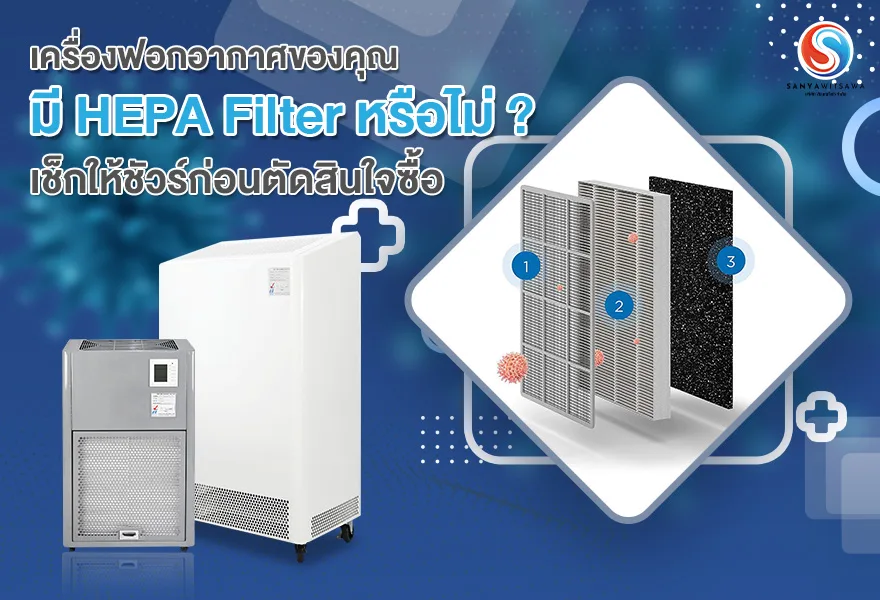
Does Your Air Purifier Have a HEPA Filter? Make Sure Before You Buy
Does your air purifier have a HEPA filter? Make sure before you decide to buy. With our air today so full of dust and toxic smoke — and with that pollution growing ever greater in volume while the particles grow ever smaller — it has become hard to control or guard against with the ordinary methods of the past. Take PM2.5, for example: even the dust masks we wear when leaving home cannot trap particles this small. So to keep ourselves from breathing too much of that dust into our bodies, the first thing to consider is choosing an "air purifier" to use, which can help reduce dust and eliminate pathogens in our homes.
How does an air purifier work?
An air purifier (Air Purifier or Air Cleaner) is a device that helps capture and screen out the airborne foreign matter that is mostly invisible to the eye — dust, bacteria, pathogens, mould, as well as unpleasant odours such as cigarette smoke, mustiness, and bad smells in the home. The purifier draws air into the unit through a filter to trap airborne foreign matter, then releases purified air in its place, allowing us to breathe safely into our lungs, free of dust and disease.
In the past, the performance of ordinary air purifiers on the market would have been enough to screen impurities from the air. But as we all know, the problem many people — especially city dwellers — now face is PM2.5, a tiny particle invisible to the naked eye that ordinary filters cannot capture at full efficiency. So when choosing an air purifier to place at home or in any other setting, you should study the information thoroughly — for example, does the air purifier you are about to buy use a HEPA filter to do the filtering…?
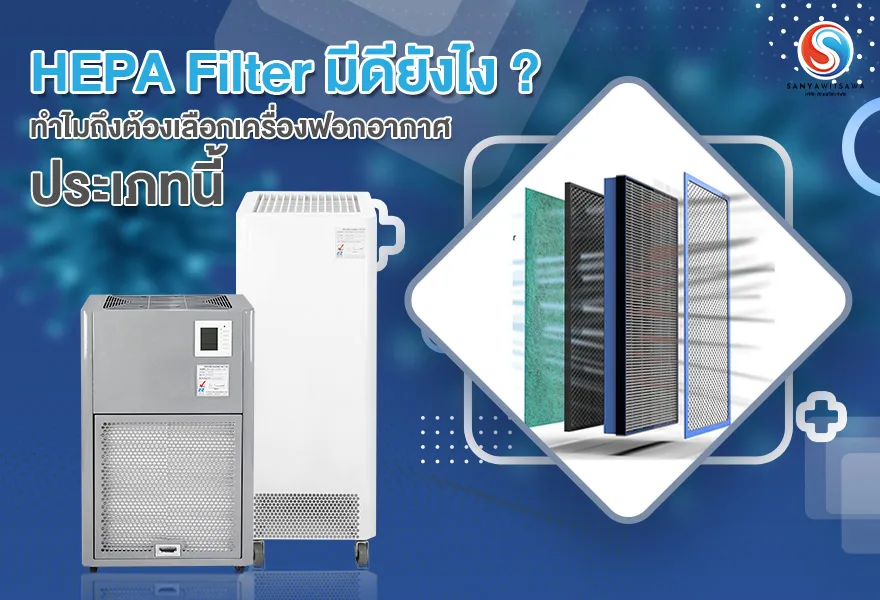
What Makes a HEPA Filter So Good? Why You Should Choose This Type of Air Purifier
The HEPA air filter — short for "High Efficiency Particulate Air Filter" — is a high-quality air filter made of fiberglass woven so finely that it is highly capable of filtering very small particles.
The term High Efficiency Particulate Air, the origin of the name HEPA, refers to air-purification and pollutant-filtration performance higher than the ordinary kind. When applied to the filter of an air purifier, it means a greater and finer capacity to capture dust: a HEPA filter can capture particles as small as 0.3 micron (many times smaller than PM2.5 dust) at up to 99.999%. Made with advanced-fiber technology, it ensures that even the very smallest dust — along with other impurities such as pollen, smoke, and even airborne bacteria and mould — can be thoroughly captured by this HEPA filter, for effective, clean and pure air filtration.
That said, this does not mean a HEPA filter cannot capture impurities smaller than 0.3 micron, because the specifications above are merely the standard criteria for using the term HEPA. Today there are many grades and standards of HEPA filter, and some grades can effectively filter impurities smaller than 0.3 as well. These are commonly seen in hospitals and clinics that require strict infection control, so as not to affect operations and pathogen control.
The differences between the various grades of HEPA filter can be observed easily by looking at the number following the letter "H": the higher the trailing number, the higher the filtration capability.
- HEPA H14: in 1 litre of air, a 0.1-micron impurity has a "0.005%" chance of passing through.
- HEPA H13: in 1 litre of air, a 0.1-micron impurity has a "0.05%" chance of passing through.
- HEPA H12: in 1 litre of air, a 0.1-micron impurity has more than a "0.5%" chance of passing through.
- HEPA H11: in 1 litre of air, a 0.1-micron impurity has up to a "5%" chance of passing through.
- HEPA H10: in 1 litre of air, a 0.1-micron impurity has more than a "15%" chance of passing through.
As you can see, the higher the grade of the filter, the greater its filtration precision. So if you want to stay safe from the dangers of tiny PM 2.5 dust, as well as pathogens and the various airborne pollutants invisible to the naked eye, choosing a high-grade HEPA air filter (H13–H14) is the best answer.
And for anyone looking for a high-efficiency air purifier with a HEPA filter:
HCU by Sanyawit, the pathogen-controlling air purifier for better health.
The HCU by Sanyawit pathogen-controlling air purifier is an excellent answer, because the HCU can thoroughly and comprehensively filter pollutants, PM2.5 dust, pathogens, bacteria, impurities, and the various tiny airborne particles mixed into the air. As an air purifier fitted with a HEPA filter of leading-hospital grade, you can be confident that air passing through the HCU air purifier will be clean, pure and free of contaminants — guaranteed by our experience installing clean-air systems in leading hospitals, clinics and healthcare facilities nationwide. We can say it answers every clean-air need in a single machine, and will not disappoint.
Moreover, our air purifier delivers high airflow yet runs at a quiet 50 decibels, so it does not disturb work or living and can be installed in a bedroom or patient room without affecting rest. Every HCU has passed the hospital sterile-room standard tests of a Third Party company, so its performance is assured: thoroughly clean, filtered air that lets you breathe deeply, with no more contaminants to trouble you.
These days, air purifiers vary too widely in price between cheap and expensive, but if you want everything in one machine without frequent replacements, choosing a high-performance air purifier is one way to save money in the long run — and it improves our living conditions before our very eyes, well worth the price. Because investing in your health is the best investment of all!
HCU by Sanyawit, the clean-air leader meeting Ministry of Public Health standards.
To claim an air purifier of your own, you can contact us at any time.