
5 Things You Should Know About Clean Rooms (Clean Room by Sanyawit)
A clean room, also known as a sterile or contamination-controlled room, is a critically important space in both the medical and industrial sectors. This includes hospitals, inpatient wards, dental rooms, delivery rooms, operating theatres, and cadaver (anatomy) rooms, as well as factories and manufacturing plants that must control the level of pollutant and particulate contamination. Because a clean room must meet stringent standards for contamination control and a high level of cleanliness, you can be confident that every operation carried out inside it maintains a high standard of cleanliness and safety, posing no risk to its users. For any organization that needs to keep its working environment clean at all times, having a clean room that meets the proper standards is therefore an essential consideration that should not be overlooked.
So, if you are someone who is interested in clean rooms, today Sanyawit — a specialist in sterile clean-room systems — has gathered some valuable information about clean rooms to share with everyone.
5 Things You Should Know About Clean Rooms
- What is a clean room?
A clean room is a room in which the levels of particles, dust, pathogens, and various contaminants are controlled so as not to exceed defined limits. It also involves controlling other factors that may affect operational and production performance, such as air velocity, temperature, pressure, and humidity, all of which directly affect the environmental conditions within the room.
This is especially true of clean rooms installed and upgraded by the Sanyawit team, because we apply rigorous control at every stage of the work, raising the levels of cleanliness, safety, and confidence beyond what was achievable before.
- What are the specific properties of a clean room?
For clean rooms in factories or manufacturing plants, fairly specific properties are controlled in order to maintain the cleanliness standard of the product, including:
The temperature suitable for a clean room is typically specified within a range of 72 oF (22.2 oC) ± 0.25 oF (0.14 oC). Temperature is an important factor that must be controlled within a clean room, because it is related to the growth of microorganisms; it is also set according to the requirements of the production process.
A relative humidity of approximately 50 ± 10 % plays a role with respect to the product. If the humidity inside the room is not appropriate, it can damage the output, because some products contain materials that readily absorb moisture; if the humidity is too high, it can cause rust or damage to the product itself.
The pressure inside the room should always be positive. For rooms with differing cleanliness levels, a pressure differential of at least 0.05 inches of water is required.
Lighting of 1,080 - 1,620 lux (where no specific value is stipulated).
- Types of clean rooms
Clean rooms can be classified by their pattern of airflow as follows:
Conventional Clean Room - The cleanliness level of this type of clean room is approximately Class 1,000 - 10,000. It uses airflow similar to a typical air-conditioning system, employing a HEPA filter but with a higher number of air changes, which helps reduce contamination within the room.
Horizontal Laminar Clean Room - The cleanliness level of this type of clean room is approximately Class 100. It uses a constant-velocity airstream flowing through a HEPA filter, with the unit installed across the entire area of one of the room's walls. Air that enters the clean space is drawn back up toward the top of the ceiling and returned to the air handler. It is commonly used in the electronics industry, biology labs, and so on.
Vertical Laminar Flow Clean Room - This type of clean room has a cleanliness level of approximately Class 100. HEPA filters are installed across the entire ceiling; air flows down from the ceiling, through the HEPA filters in a vertical (downward) direction, and then through the interior of the room, keeping it clear before returning to the cooling air handler. It is especially suited to the electronics industry.
- Types of clean rooms
Industrial Clean Room - A clean room commonly used in various chemical industries, such as the electronics industry, the paint manufacturing industry, the film manufacturing industry, and so on.
Biological Clean Room - A clean room in which the level of bacteria is controlled and the internal pressure is set higher than that of adjacent rooms, in order to prevent contaminants from neighboring rooms from flowing into the clean room. It is commonly used in biology laboratories, the pharmaceutical manufacturing industry, operating theatres, dental rooms, disease-control rooms, and so on.
Biohazard Clean Room - A clean room commonly used in laboratories that work with viruses and substances hazardous to health. The internal pressure is set lower than that of adjacent rooms in order to prevent the spread of pathogens and various substances to the outside.
- How are clean room Classes divided?
Class 100 means a room containing no more than 100 particles of 0.5 microns or larger per cubic foot of air.
Class 1,000 means a room containing no more than 1,000 particles of 0.5 microns or larger per cubic foot of air.
Class 10,000 means a room containing no more than 10,000 particles of 0.5 microns or larger per cubic foot of air.
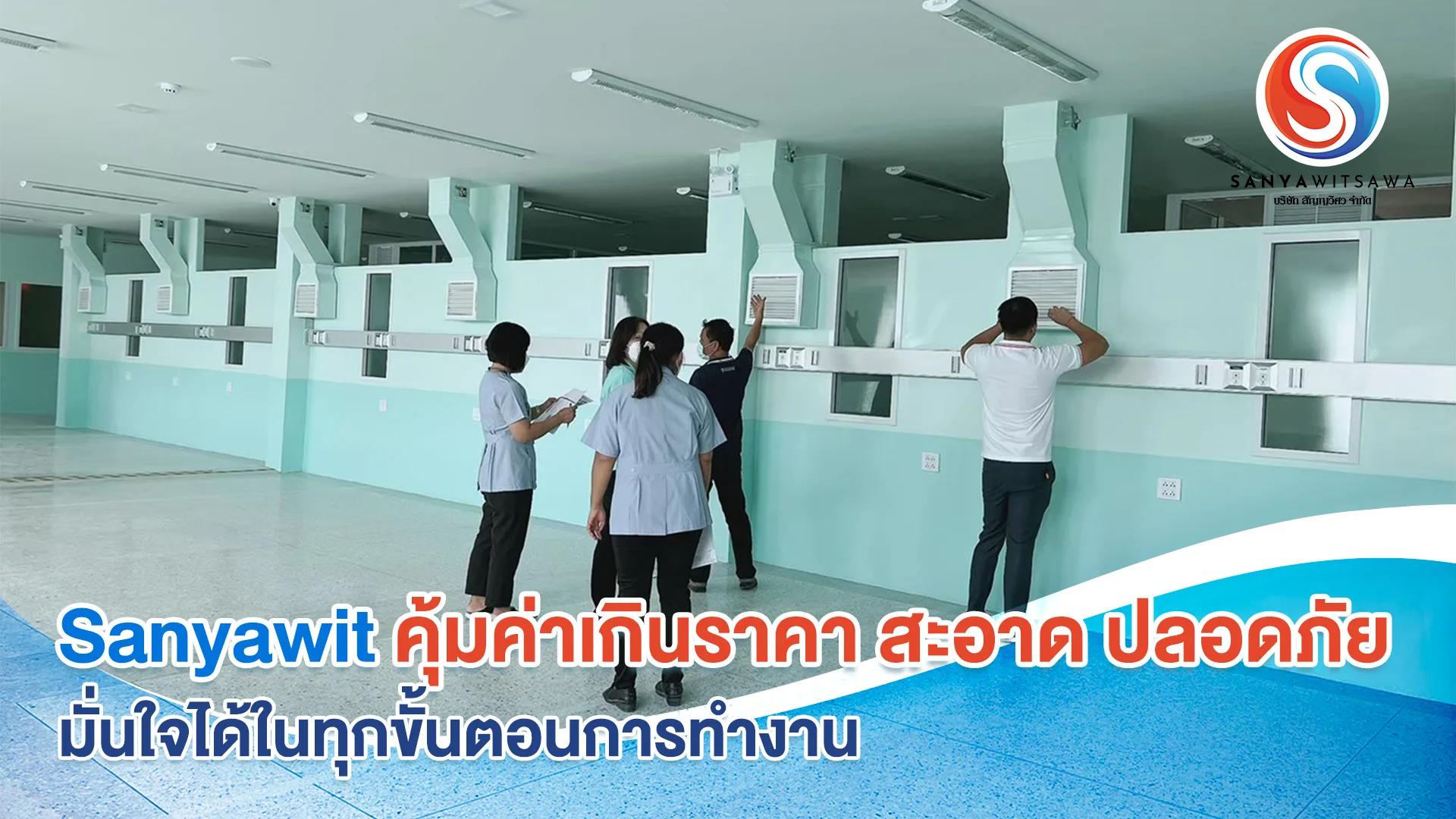
At Sanyawit, we are ready to raise the standard of sterile rooms, making them clean and safe to the level of leading hospitals. With more than 10 years of operating experience and a track record of installing and upgrading more than 600 clean rooms for both the public and private sectors, you can have complete confidence in our standard of work. Every component used in our operations is fully certified by the Ministry of Public Health.
"Sanyawit — worth more than the price: clean, safe, and dependable at every stage of the work."
When you think of effective contamination control and a highly experienced team, think only of Sanyawit.