
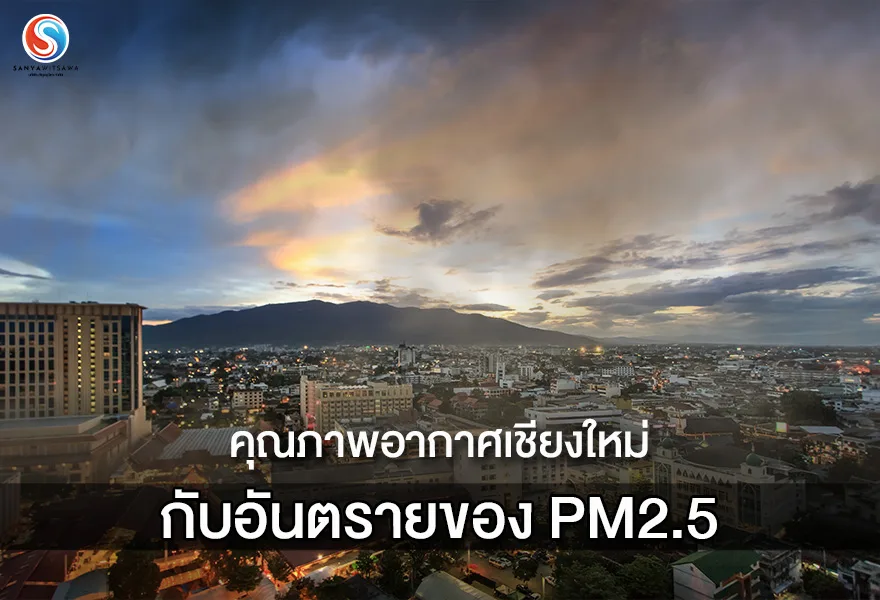
Chiang Mai's Air Quality and the Dangers of PM2.5
Chiang Mai's air quality and the dangers of PM2.5: an air problem every life must care about.
Chiang Mai, both in the past and today, remains a beautiful province, surrounded by abundant natural forests and mountains, and is one of Thailand's most important cultural centres. But what has gradually changed Chiang Mai from its image of old is the amount of dust — PM2.5 — that rises year after year, from burning, forest fires, and the growing development within Chiang Mai's city itself by the day. For those reasons, Chiang Mai has become the city with the most worrying pollution problem.
Because today Chiang Mai is facing a severe air-pollution crisis, particularly the problem of fine particulate matter PM2.5, which exceeds the standard to a worrying degree, it is having a major impact on public health and quality of life. The PM2.5 readings in Chiang Mai sometimes spike so high that the city becomes the most air-polluted city in the world, and that pollution keeps increasing in volume every year, becoming a problem that has long affected the quality of life of Chiang Mai's people.
The IQAir website, which reports air quality worldwide, found that Chiang Mai, Thailand, had an AQI of 188, which is a pollution level in the red zone (AQI = 151–200), meaning it affects everyone — claiming the world's number-one spot as the major city with the most pollution. Meanwhile, the world's second and third places were Delhi, India, with an AQI of 186, and Kolkata, with an AQI of 181, respectively. As you can see, Chiang Mai's pollution readings are nothing to be complacent about. And it is not only in Chiang Mai: many provinces across the North also face air conditions that exceed the standard. The provinces where PM2.5 exceeds the standard and reaches the red level include Nan, Phayao, Lampang, Lamphun, Sukhothai, Udon Thani, Chiang Rai, Chiang Mai, Loei, Phrae and Mae Hong Son.
Make no mistake: if these pollution problems are allowed to continue, effects on health and daily life are sure to follow.
The cause of the problem
The main cause of the air-pollution problem in Chiang Mai and northern Thailand is open burning, particularly the burning of cornfields and the burning of forests to clear topsoil. Burning cornfields is the method farmers use to dispose of crop residue after harvest in order to prepare the land for replanting, because it is the fastest and most economical method, even though it damages the environment.
In addition, northern Thailand has a basin-shaped terrain, which makes the dusty smoke dense and unable to disperse well. This is the reason why northern Thailand has air pollution high enough to be more worrying than other regions.
The effects
The effects of air pollution in Chiang Mai are severe on public health, particularly respiratory disease, heart disease and lung cancer. They also damage Chiang Mai's tourism and economy. In short, the effects of air pollution can affect every sector, but the most important part remains health.
The 6 most common serious diseases that often come with air pollution
- Asthma (Asthma)
This is a disease involving chronic inflammation of the bronchial lining, together with an abnormal condition in which the bronchi are hypersensitive to various triggers. Air pollution is one of the causes that can give rise to this disease.
- Allergic rhinitis (Allergic Rhinitis)
Dust particles, as well as fine pollutants, contain various toxins such as heavy metals, which cause irritation in the nasal cavity and upper respiratory tract, triggering allergy flare-ups and difficulty breathing.
- Bronchitis (Bronchitis)
Breathing a large amount of pollution dust particles into the lungs causes acute inflammation of the major bronchi, leading to increased coughing and phlegm. And once the immunity of the major bronchi declines, it becomes easy to develop viral and bacterial infections, causing the disease to worsen further.
- Heart attack (Heart Attack)
In patients who already have coronary arteries narrowed or blocked by fat, breathing toxic dust and pollution into the bloodstream causes inflammation and reactions in the blood vessels that can block them, ultimately leading to an acute heart attack. This is one of the diseases that should be closely watched and guarded against.
- Arrhythmia (Arrhythmia)
Air pollution breathed into the bloodstream can trigger the heart to beat irregularly, which can lead to heart failure and pulmonary oedema.
- Stroke (Stroke)
Air pollution causes the blood vessels in the brain to harden, the blood circulation to thicken beyond normal, and blood pressure to rise — all factors that can lead to cerebral ischaemia resulting in partial or full paralysis.

Measures to Cope with Dust / PM2.5 Levels
Chiang Mai and the relevant agencies have tried to implement various measures to cope with this problem, including banning open burning, raising awareness among the public, and using technology to monitor and control burning. However, solving this problem requires cooperation from every sector, including effective management at the local level and support at the national level. Solving the air-pollution problem in Chiang Mai and northern Thailand is a challenge that requires continuous cooperation and effort from every sector in order to improve air quality and the public's quality of life.
How can Sanyawit help you?
Sanyawit is a business established to carry out air-improvement work under the standards of the Ministry of Public Health. Here we offer end-to-end design, installation and consultancy services for clean-air systems in the home.
Beyond this, we are also a leader in the best air systems in Thailand. We are ready to install for you right at your home and workplace, with every step carried out by experts experienced in upgrading the air systems of hundreds of leading hospitals, with particular expertise in dealing with PM2.5 dust, pollution and airborne germs.
And to eliminate the PM2.5 air pollution that is troubling everyone, Sanyawit is pleased to present the HCU germ-control air purifier, an innovation designed for truly clean air purification. Its filtration performance reaches as high as 99.999% at 0.3 micron, able to filter out fine contaminants many times better than ordinary air filters on the market, filtering dust, pollution, germs as well as bacteria and the various small contaminant particles that may cause disease.
In addition, the HCU air purifier also delivers high airflow yet is quiet at just 50 decibels, so it does not disturb work or living and can be installed in a bedroom or patient's room without disrupting rest. Every HCU has passed hospital clean-room standard testing by a Third Party company, so you can be confident in its performance, filtering the air perfectly clean and free of troublesome contaminants.
Chiang Mai, a treasure of Thai heritage and an important tourist city
Do not let air pollution obscure the charm of Chiang Mai. Taking care of yourself is one part of the approach to protecting your health, but at the same time, trying to work together to prevent the air-pollution problem is an important matter in which every sector should cooperate and help find solutions, for the future of Chiang Mai and the children who live here.
Our Sanyawit sends encouragement to the people of Chiang Mai and other provinces who must face pollution problems in every sector. We are ready to deliver and install our clean-air system to raise quality of life with visible results, while every sector works together to tackle the pollution problem. Because the matter of air truly is important to our health and way of life.
If you are interested in owning a clean-air system, you can contact us at any time.