
Home-Decorating Guidelines for a Dust-Free, PM2.5-Reduced Home and Better Health for Everyone Inside
Home-decorating guidelines: "If the air in your home is good, your daily life is good along with it." With today's air full of dust and pollution, no matter which way you turn you meet nothing but a grey haze formed from the huge amount of dust in the air, until our bodies grow accustomed to inhaling that dirt without a second thought. But have you ever noticed why, when we travel to a distant province and breathe truly pure air into our lungs, we feel happier and more refreshed than usual? That is because, deep down, our bodies crave clean air to replace the dirty air we inhale each day.
Of course, once your mood and mental health improve from having clean air around you, your life gradually improves along with it. Today, numerous research studies say with one voice that air quality has a direct effect on our brain performance. Living in an area with poor air, with PM 2.5 dust pollution exceeding the standard, lowers our cognitive control and is also an accumulating hazard that can lead to dementia and even Alzheimer's. And that is before counting the other health problems lining up to trouble us.
But, of course, given various factors — careers, convenience and quality of life — most people cannot live in a remote area with pure air all the time, nor can they change the air conditions of the town they live in. Since we cannot avoid facing poor air conditions from outside, turning our home into a Safe Zone — a dust-free, germ-free space where you can breathe deeply — is therefore another important option that cannot be overlooked.
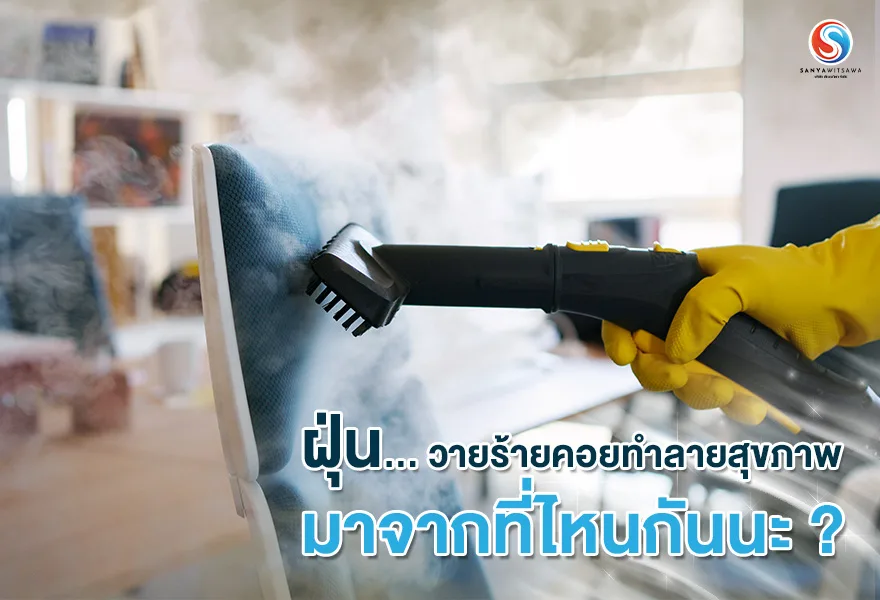
Dust… the Villain Destroying Our Health: Where Does It Come From?
Have you ever noticed that no matter how diligently you clean your home, within a few days you start to see dust clinging to various spots again? That is because the dust accumulating inside a home arises from two routes. The first is dust from outside, such as PM2.5 pollution dust, soot from vehicle exhaust, or even dust from burning. This kind of dust has extremely small particles, and even with the doors and windows closed tight, it can still slip in, and it is dangerous, directly affecting our respiratory system and brain.
The other type is dust that forms naturally on its own, arising from the use of everyday household items. How much there is depends on what factors in our home favour the formation of dust — for example, a home that is very damp will have more dust accordingly, or a home with lots of fabric items and lots of decorations will have more dust to match. This dust forms every day, mixed with dust mites, viruses and various bacteria, which affect allergies, lung disease and the respiratory system.
As you can see, "dust," though it may seem a minor thing, is dispersed around us all the time and is ready to bring countless health problems to our bodies. Ordinary cleaning may still not be enough to eliminate dust from the home permanently, but if we pay attention right from the home-design and decorating stage to make the home as safe from dust as possible, it is certain to make our lives better than before. Because there is nothing better than living in a home with clean air all around.
So how should you decorate your home to make it dust-free, safe, and free of PM2.5 and airborne germs?
Today, our Sanyawit will take everyone to find the answers together.
5 Guidelines for Decorating a Dust-Free, Safe Home That Effectively Reduces the PM2.5 Around Us
1) Decorate a dust-free home by reducing the air vents on the northeast side of the house
Why the northeast air vents in particular? It is because vents from this direction face the cold winds. People in the past liked to design homes that opened to receive air from this direction so that the house would be cool and well ventilated. But those reasons no longer hold true for today's air conditions, because nowadays PM2.5 dust tends to break out heavily during the cold season, since dust particles form when cold air clashes with warm air. So a home located in a dust-dense area should reduce its air vents, or angle the house away from the northeast, in order to reduce dust from outside blowing into the home.
So what do you do if closing the vents leaves the air stale? That is no big problem, because today there are clean-air purifiers and home air-supply units with the ability to help circulate the air inside the home. So even in a sealed room with no vents, we can still circulate the air inside the room comfortably and without feeling stuffy.
2) Decorate a dust-free home by adding green space inside the home
Trees are the best natural lungs, so to reduce the amount of dust inside our home, having plants that can purify the air indoors is a very important aid. When designing our home with green space, or arranging an ornamental garden, you should choose plants with needle-like leaves — small, sharp and dense leaves — especially in urban areas with a lot of dust. If you have space around the home, you should plant grass to cover the ground instead of pouring concrete, and you can use plants to decorate the walls instead of using tiles.
Designing a home with green space not only helps trap dust but also helps add more humidity to the air, and makes the area around our home look shadier and more pleasant. It also adds enough oxygen inside the home so that we can breathe freshly and fully at all times. So anyone who wants a dust-free, safe home should not forget to buy some good plants to decorate with.
3) Decorate a dust-free home by avoiding materials that trap dust easily
Did you know? The choice of decorating materials and certain home designs can likewise generate dust — for instance, the use of intricately patterned wrought iron that is hard to clean, walls designed with exposed brick, or brick laid without plaster, as well as the use of dust-generating materials such as curtains, woollen fabrics, velvet and carpets. So, when it comes to designing and decorating a dust-free home, the homeowner should consult the home-building company managing the work to avoid this problem early on.
So what kind of material should you choose to stay dust-free? The simple idea is to focus on materials and decorations that are easy to clean, without intricate patterns or joints, and to avoid dust-collecting fabric-family materials as much as possible.
4) Decorate a dust-free home by installing an air purifier and air filter
A clean-air purifier and air filter are indispensable for homes in this era, because toxic PM2.5 dust is dispersed around us all the time and cannot be removed by ordinary cleaning. With particles so tiny that they can enter the inner body, inhaling them over a long time will certainly undermine our health and lifespan. So having one or two good air purifiers within the home is a worthwhile investment, another option to consider.
Installing a clean-air purifier is one of the methods that can genuinely help reduce the amount of dust inside the home. Even so, it is necessary to clean the filter and filter sheet regularly, since they are a place where dust and germs accumulate. And if you use doormats and rugs in the home, you should make a point of cleaning them every week to reduce the build-up of dust inside the home.
5) Decorate a dust-free home by designing furniture that reduces dust-collecting areas
One of the reasons the air in our home is dirty and dust clings to it all the time is having furniture that is a place for dust and dirt to accumulate. Because some furniture is hard to clean, a large amount of dust accumulates accordingly. The spots that are hard to clean and become a home for the dust army are the empty areas behind cabinets and on the ceiling, because they are hard-to-reach and hard-to-clean areas.
So, at the home- and furniture-design stage, you should choose furniture of an appropriate height, or fitted up to the ceiling, in order to minimise dust-collecting areas. If you cannot build cabinets up to the ceiling, adapt by using storage boxes or covers to make cleaning easier, and make a point of regularly cleaning the various nooks and corners of the home, so that no new place for dust to accumulate arises again.
Decorate a dust-free, safe, PM2.5-free home with Sanyawit's air-system improvement service
Sanyawit is pleased to present our end-to-end home-decorating and clean-air-system improvement service. We are clean-air-system specialists, certified to Ministry of Public Health standards, with experience upgrading the air systems of hundreds of leading hospitals. Our services also cover homes, workplaces and other places that need clean, germ-free air.
- Consult: We provide design consultancy that best matches the user's needs.
- Design: We design correctly according to Ministry of Public Health standards.
- Supply: We select equipment for maximum performance, suited to the intended use.
Beyond this, we also have an innovation designed for truly clean air purification — the HCU germ-control air purifier, the best air purifier available today. Its filtration performance reaches as high as 99.999% at 0.3 micron, able to filter out fine contaminants many times better than ordinary air filters on the market, filtering dust, PM2.5 pollution, germs as well as bacteria and the various small contaminant particles that may cause disease, perfectly clean.
That's not all!! The HCU air purifier from Sanyawit also delivers high airflow yet is quiet at just 50 decibels, so it does not disturb work or living and can be installed in a bedroom or patient's room without disrupting rest. Every HCU has passed hospital clean-room standard testing from a Third Party company, so you can be confident in its performance, filtering truly clean air free of troublesome contaminants.
Sanyawit, a clean-air specialist, certified to Ministry of Public Health standards.
If you are interested in our services or would like a consultation, you can contact us at any time.