
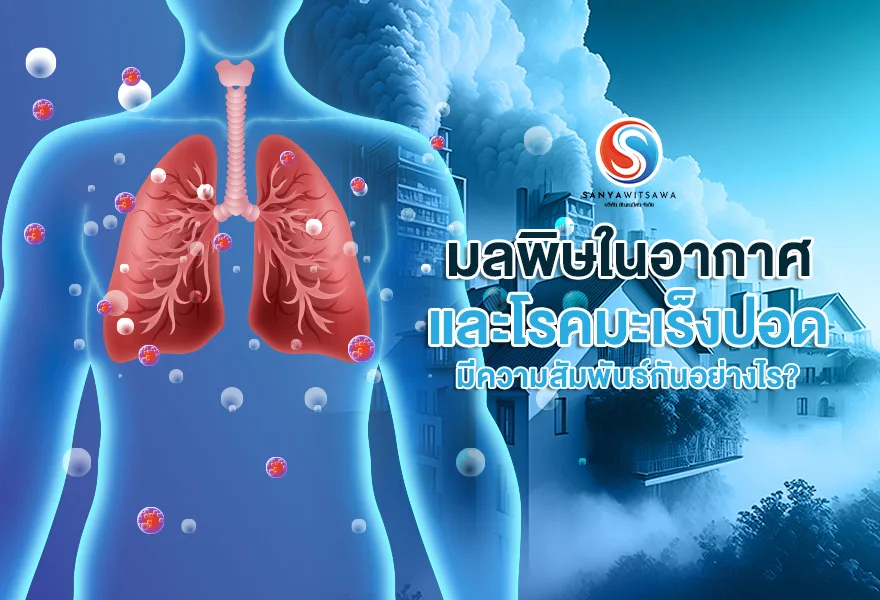
How Are Lung Cancer and Air Pollution Related?
How are lung cancer and air pollution related? Today, environmental problems, including air pollution, have a major influence on our health and way of life. Because "pollution" is unclean air resulting from impurities or toxins contaminating it beyond standard levels, when left for a long time it lowers air quality until it becomes toxic to health and the environment. It is one of the foremost dangers and hard to prevent, because we must breathe air into our lungs all the time, which means we continually take in and accumulate pollution as well. Finding ways to prevent or reduce the pollution around us from the very start is therefore the best solution for keeping ourselves healthy.
In general, air pollution can arise from human activity and can also occur naturally, whether from the burning of fuel, transportation, industry, or other natural sources. It is saddening to have to accept that this pollution increases by the day and has become the cause of various diseases that follow, such as respiratory diseases, allergic skin rashes, and the disease no one wants most of all: "lung cancer."
In this article, Sanyawit will take you through the connection between "air pollution" and "lung cancer" to see how they are related, whether breathing in and accumulating PM 2.5 air pollution in the lungs over a long period can truly trigger the symptoms of lung cancer, and what other dangers pollution holds. Let's find the answers together.
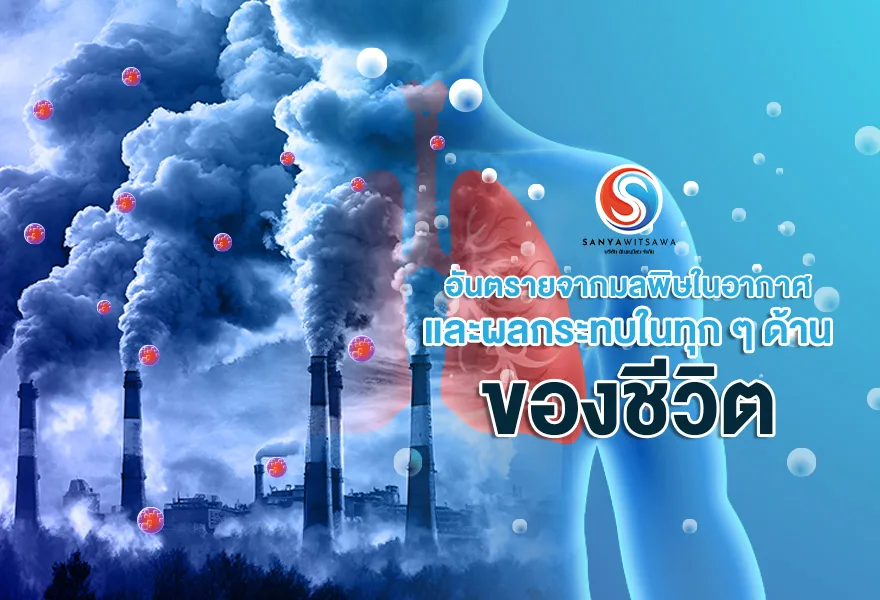
The Dangers of Air Pollution and Its Impact on Every Aspect of Life
The dangers of indoor pollution
- Indoor air pollution can arise from the use of various chemicals and sprays as well as the use of gas in the home. Although in the short term it may not be that harmful to the body, over a long period those seemingly minor pollutants accumulate more and more in our bodies until they begin to affect health. In some cases they may cause acute symptoms such as coughing, sneezing, and shortness of breath, and they also cause long-term health problems that develop into chronic conditions such as vascular disease, lung disease, heart disease, and lung cancer as well. This includes allergic reactions caused by certain chemicals used in the home, such as fumes from nail polish, cigarette smoke, or even lead in house paint. It can be said that air pollution surrounds us on all sides.
The dangers of outdoor pollution
- Outdoor air pollution, such as the dust, smoke, and dirt we encounter on ordinary streets, is a pollution problem that is hard to avoid if we still need to spend time outside the home often, because air pollution comes from every direction, whether on roads filled with exhaust fumes, buildings with pollution from heating, and industry arising from in-building activities, or even various pathogens that may be spreading through the air without our noticing. These all affect our physical health as well as skin health, causing rashes and hives as well.
The dangers of exposure to air pollution
- If we breathe pollution into the body in large amounts, it may cause nausea, dizziness, and possibly vomiting as well. Moreover, some airborne chemicals can cause skin allergies such as itching, stinging, burning, red rashes, and itchy bumps, and so on. But of course, among all these symptoms, what most people least want to encounter is cancer, because as everyone knows, cancer is a dangerous disease that still has no cure. Once cancer develops at one site, there is a chance it will spread to other organs, causing numerous health problems from the start of a single cancer. Knowing this, let's look in detail at the dangers and frightening nature of "lung cancer."
Lung cancer, one of the diseases that claims the most Thai lives
As you may already know, lung cancer is one of the leading causes of death among Thai people and a type of cancer that is hard to cure. Most lung cancer patients show few symptoms in the early stages, but signs indicating the disease appear once the cancer has grown more. However, lung cancer can be cured if detected at an early stage. Lung cancer arises from the rapid growth of abnormal cells to a point where they can no longer be controlled, which gives rise to clusters of abnormal cells that can be detected once they are large in size, numerous, and have already spread to various parts of the body. Lung cancer is divided into 2 types, namely:
Small Cell Lung Cancer: The cells grow and spread rapidly, causing patients to die quickly; it is found in 10 – 15% of cases.
Non-Small Cell Lung Cancer: It spreads more slowly and can be cured by surgery if detected at an early stage. This type of cancer accounts for about 85 – 90% of cases.
Risk factors for lung cancer
- Smoking – Cigarettes are the primary factor causing lung cancer, as well as other types of cancer. Smokers have a risk of lung cancer up to 10 times that of non-smokers.
- Secondhand smoke – Even without smoking, receiving secondhand and thirdhand smoke by inhaling it leaves residual toxins that cause cancer, which in some cases spreads even faster than in the smokers themselves.
- Working in industries with carcinogens – For those who work in industry, exposure to carcinogens such as chromium, asbestos, radon, and nickel is one of the causes that can give rise to cancer.
- Environments with toxic dust – Studies have found that PM2.5 dust raises the risk of lung cancer by as much as 1 – 1.4 times, which is considered as serious as smoking.
- Genetics – Although lung cancer is not directly hereditary, it has been found that if there is a history of family members developing lung cancer at a young age, other family members also have a higher risk.
How do lung cancer and pulmonary tuberculosis differ?
- Serious lung diseases are not limited to lung cancer; there is also tuberculosis. Pulmonary tuberculosis arises from a bacterial infection, and its symptoms tend to develop gradually, whereas lung cancer arises from abnormal division of lung cells, which takes time to show symptoms. This can make the symptoms similar, such as chronic cough, coughing up blood, or loss of appetite and weight loss, making it difficult to distinguish the diseases by symptoms alone. It therefore requires additional testing, such as collecting sputum for culture or performing bronchoscopy to take a tissue sample from the lung, and so on.
Can air pollution and PM2.5 cause lung cancer?
- Amid the worsening air-pollution crisis worldwide, in cities, outside cities, industrial areas, and other areas, the WHO has stated that the body's exposure to PM2.5, or dust particles no larger than 2.5, not only has a greater chance of seeping into the bloodstream than dust larger than 2.5 and can affect the body's functioning, but also, if PM2.5 is accumulated over a long period, contributes to lung cancer as well. This is according to information from the medical journal Oncology Letter – PMC5920433.
Sanyawit, the leader in clean-air systems ready to protect you from every pollution problem
- Sanyawit or Sanyawitsawa is a clean-air-system, or air-purification-system, provider with long experience. We know well what is needed to make your home or residence one with clean, safe air that raises quality of life alongside the beauty of the place. We always care about every health concern of our customers, and to minimize problems during work, we design and install every site with care, prioritizing the safety of both the service provider and the service recipient. In addition to cleanliness and safety, we attend well to detail, work fast, and can be trusted in every operation.
What are the benefits of using Sanyawit's clean-air services?
- Free design and budget estimation, with a design and price-estimation period of no more than 2 days.
- Consultation to obtain quality that matches your needs and saves budget while still achieving the best quality.
- Every type of equipment has been used in real hospital clean rooms in over 600 rooms during the Covid-19 situation, so we can certainly guarantee our operational standards, keeping you safe and worry-free from harmful pollution.
- We take into account the beauty of the place alongside operational performance, so you can decorate your home to be beautiful while also clean and safe at the same time, under Sanyawit's design work, to deliver the best possible results.
Making your home a place safe from PM2.5 dust and air pollution not only keeps you safe from cancer but also raises your quality of life. If the air around your home is good, the people in the home will be healthier too, especially in homes with children, the elderly, or patients who are particularly sensitive to airborne triggers, where having a clean-air filtration system is indispensable, because cleaning the home alone is not enough to remove the impurities invisible to the naked eye. Our Sanyawit is therefore ready to step in and help you with that, alongside you at every moment.
"Because your every breath is precious." If you are interested in learning more or would like to use the clean-air system installation services of Sanyawit, you can contact us at any time.