
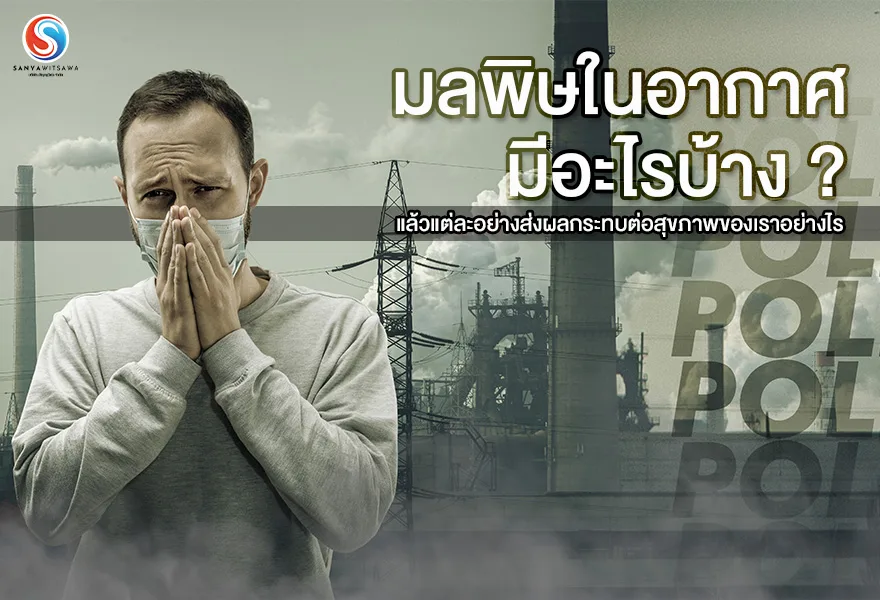
What Air Pollutants Are Out There, and How Does Each One Affect Our Health?
What air pollutants are out there, and how does each one affect our health? It is a hard truth to accept that in recent years, Thailand's air quality has clearly deteriorated — especially over the past 2–3 years, where the problem of smoke, dust and pollution has greatly affected daily life for people in Bangkok, its surrounding provinces, major cities and industrial zones. According to data compiled by the Pollution Control Department, smoke from burning rubbish, rice fields, farm plots or agricultural residues out in the open, combined with toxic gases from traffic and industry in major cities, affects the health of Thais on a broad scale. Although most of these effects do not appear immediately, there is no denying that Thais breathe in airborne dirt every day, gradually wearing down our health.
Besides health problems, air pollution also affects our quality of life. Allergic rashes, irritation, nasal congestion, or being unable to draw a full breath and feel fresh and clear — these too are effects of pollution. So air pollution is not some trivial problem to overlook; we should find ways to deal with it before it harms our health any further.
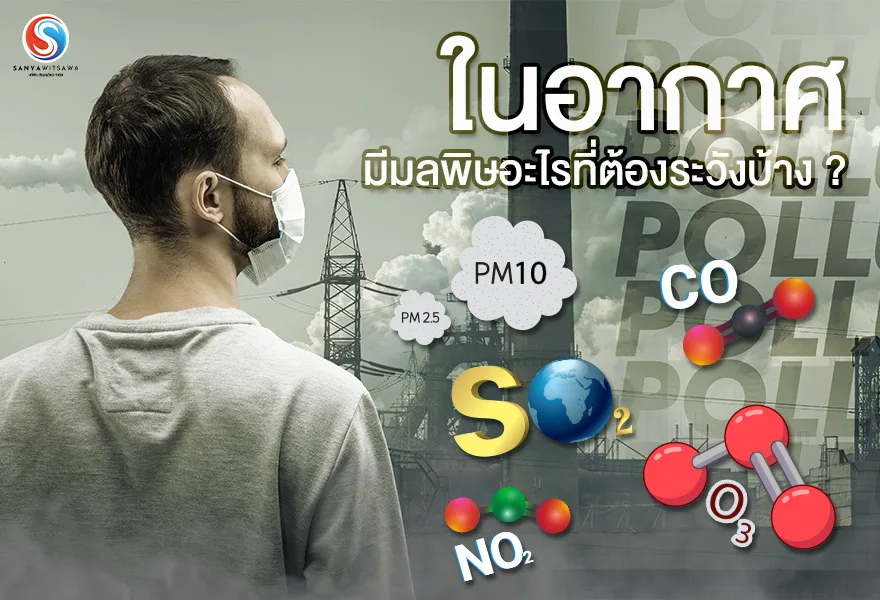
Which air pollutants do we need to watch out for?
In Thailand, the agency responsible for monitoring and reporting on air pollution is the "Pollution Control Department," whose duty is to report the Air Quality Index (AQI) — a figure the general public can easily understand, representing six types of air pollution hazardous to health, namely:
Particulate matter no larger than 2.5 microns (PM2.5) is dust with a diameter no greater than 2.5 microns, arising from combustion by vehicles, the burning of agricultural materials, wildfires and industrial processes. It can reach the alveoli in the lungs, causing lung deterioration, bronchitis and asthma symptoms.
Particulate matter no larger than 10 microns (PM10) is dust with a diameter no greater than 10 microns, arising from fuel combustion, open burning, industrial processes, grinding, milling, or the pulverising involved in construction. When inhaled, it can accumulate in the respiratory system and is hazardous to health.
Ozone gas (O3) forms from the reaction between nitrogen oxide gases and volatile organic compounds. It causes irritation to the eyes, mucous membranes and respiratory system, and reduces lung function, leading to quicker fatigue — especially in children, the elderly and people with chronic lung disease.
Carbon monoxide gas (CO) forms from the incomplete combustion of fuel. This gas competes to bind with haemoglobin in the blood, reducing the delivery of oxygen to the body's cells — leaving the body fatigued and making the heart work harder.
Nitrogen dioxide gas (NO2) forms from the combustion of various fuels in industry. It affects the visual system and people with asthma or respiratory conditions.
Sulphur dioxide gas (SO2) forms from the combustion of fuels containing sulphur. It causes irritation to the mucous membranes of the eyes, the skin and the respiratory system, and prolonged exposure can lead to chronic bronchitis.
How does air pollution affect us?
The murky, hazy masses of air — like thick fog caused by pollution — that we have regularly seen of late certainly cause great concern for many people, because they directly affect health both in the short and long term. This concern is not unfounded, as numerous surveys and studies worldwide have found the connection.
Air pollution, of course, directly affects the respiratory system and quality of life. Besides being a nuisance and leaving you feeling less than fresh, inhaling these pollutants in large amounts or over a long time causes the toxins held within smoke and dust to gradually accumulate in the body. Over time, this becomes a factor in various diseases and a clear decline in health — no matter how healthy you were before. It truly is a problem that affects people of every age.
Because studies have found that "air pollution is a cause of death for over four million people worldwide," and it also drives a sharp rise in hospital admissions — for example, more emergency patients, more strokes, premature death from heart disease, asthma and chronic obstructive pulmonary disease, and lung cancer. Newborns in highly polluted areas tend to have lower-than-normal birth weights, and pregnant women see a higher rate of premature births.
Other clearly visible effects include dust and air pollution being a cause of respiratory tract infections in children, and possibly affecting children's brain and nervous-system development as well.
Who is at high risk in air like this?
In reality, everyone — of every sex and every age — is at risk of various diseases from pollution and air pollution, especially those who must work or spend long hours outdoors each day. But the groups that must take particular care are children, the elderly and pregnant women, as well as people with respiratory disease and those with cardiovascular disease. These groups should therefore find ways to protect themselves — by avoiding going outdoors, or, if necessary, using a mask over the mouth and nose for protection, so the body takes in as little airborne dirt as possible.
But besides protecting yourself from air pollution while outdoors, changing the environment around you — or turning the air in your home into a genuinely safe, dust- and pollution-free space — is just as important to consider, because "home" is the place where we spend the most time. If the air in the home is not clean enough, it is hard to protect our health from air pollution, since surely no one wants to wear a mask over their mouth and nose even while at home.
Don't wait until it's too late to find a solution, because treating the symptoms rather than the cause — or starting to do something only once your health has declined and spiralled out of control — is always harder than preventing it early on.
Sanyawit — or Sanyawitsawa — is a leader in clean, sterile air systems for genuinely better health. We offer design, installation and consultation services for clean-air systems in residences, with performance to the criteria of the Ministry of Public Health as the priority. With experience installing clean rooms in hundreds of hospital and clinic rooms, our Sanyawit team has deep expertise in comprehensively designing and improving air systems for all kinds of premises — whether dust, pollution, bacteria or other airborne dirt, all of it can be thoroughly eliminated, with genuinely measurable results. Because the most important things in everything we do are the safety and comfort of the user.
Beyond the quality of air and contaminant filtration, another thing Sanyawit cares deeply about is "aesthetics" — because no one wants a contractor coming in to install equipment that ends up cluttering and crowding the whole house, right? That is why Sanyawit puts care into every design and installation, ensuring both good contaminant-filtration quality and an attractive, clutter-free result. You can be one hundred percent confident that once installed, your quality of life and well-being will genuinely improve.
"One place that clears it all up — every worry resolved."
Sanyawit designs and installs clean rooms, sterile rooms and clean rooms to the standard of leading hospitals nationwide.
When you think of effective infection control and a highly experienced team, it has to be Sanyawit.