
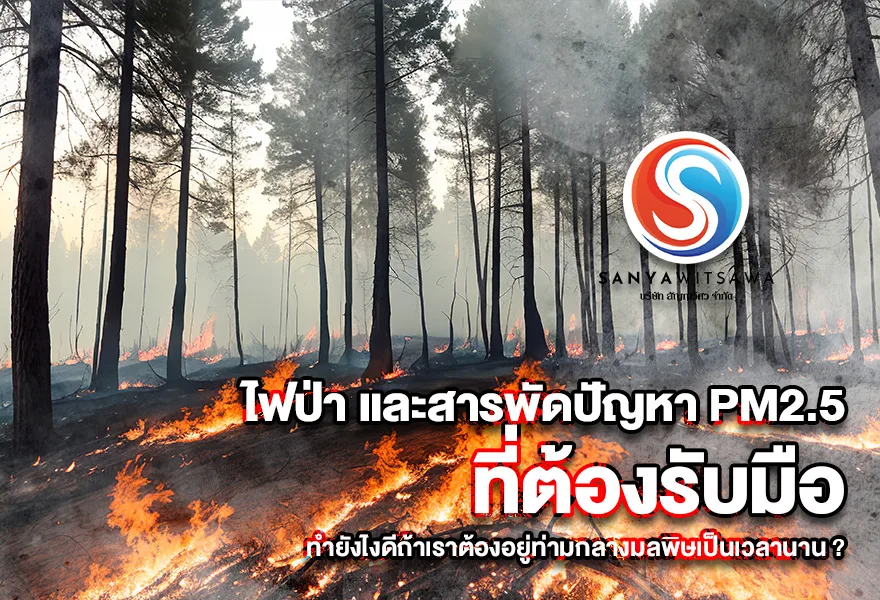
Wildfires and the Many Problems of PM2.5: How to Cope With Living Amid Pollution for Long Periods?
Wildfires, haze, and drought are crises that recur every year, especially during hot, dry seasons, and they are intensifying across many regions of Thailand — particularly in the North. The causes of wildfires can come from many factors. Some wildfires occur naturally — for example, from lightning strikes, hot dry weather, light striking mineral crystals, or branches rubbing together until sparks form. These are factors that cannot be controlled, but they also don't occur very often.
Another cause of wildfires is human behavior — for example, foraging for forest products, deliberately starting fires to stimulate the growth of mushrooms or certain plants, clearing agricultural land after harvest, and burning to clear the forest for illegal livestock grazing. These are major factors that cause wildfires, and they also create the chance for those fires to spread to a point that is hard to control. If left for a long time, the impact is not limited to the area where the wildfire occurs; the pollution from that smoke can spread hundreds of kilometers from the site of the fire, and can remain suspended in the air for months on end if there is no rain to wash it away — which, of course, surely affects health and daily living.
So what happens when there is pollution in the air for a long time?
Today, Sanyawit will take you to learn about the dangers of wildfires and the ways to protect against them together.
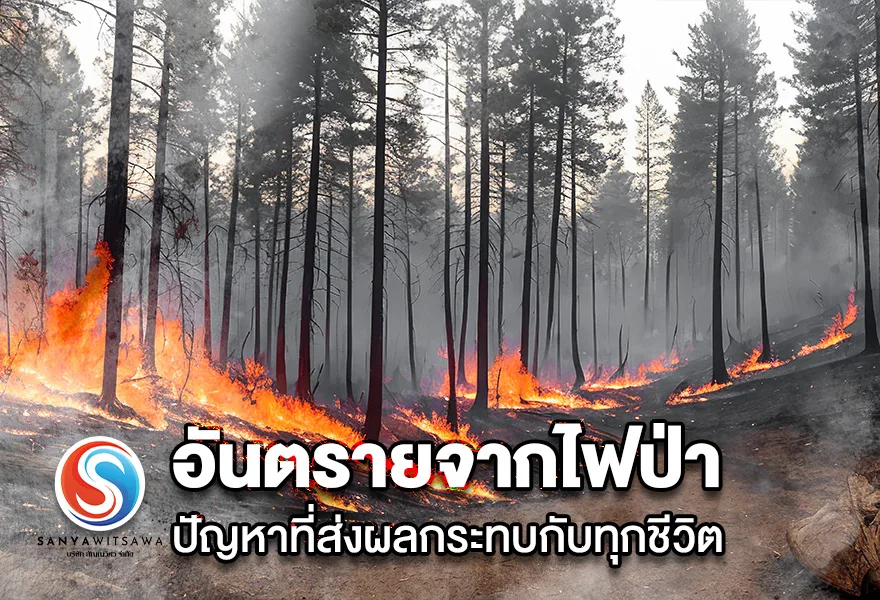
The Dangers of Wildfires — A Problem That Affects Every Life
The dangers of wildfires — a problem that affects every life
Being called a "wildfire" already means it is extremely dangerous, because if a blaze spreads on a wide scale and destroys forest land, its impact can be unimaginably vast. For one, it destroys the habitats of wild animals, destroys their food sources, and slow-moving animals are choked by the smoke until they suffocate, or else are burned to death; and in the worst case, certain wild animals whose numbers are already small may even go extinct.
The impact is not limited to animals and other living things in the forest, because wildfires are dangerous to humans and the environment as well. A wildfire produces a great deal of soot — both visible to the naked eye and invisible dust, or dust as small as PM10 or PM2.5, which is well known to be extremely harmful to health, because it is a small particle that can infiltrate the body through every avenue. This affects both daily living — causing irritation and discomfort — and reaches all the way to health impacts.
So what are the health impacts? The soot produced by the burning of a wildfire can be a major irritant to the human body and skin. If someone inhales a lot of it, the pollution from that burning will accumulate in the body until it causes allergies or serious diseases, such as asthma, ischemic stroke, cancer, and other respiratory diseases. In short, merely inhaling toxic wildfire smoke is already enough to bring a host of health problems.
What's described above is only a rough overview of the impacts of wildfires, because beyond the factors of health and daily living, wildfires also damage the image of the area, causing tourists to avoid it and leaving the economy in a slump.
What should you do when you have to live in an area with regular wildfires?
What should you do when you have to face wildfire pollution unavoidably? Here are some basic measures to take:
- Check the air quality in real time so you know how much the current wildfire situation is affecting the community. You can check air quality through the news reports of the Pollution Control Department, or by using a tool or application to check air-pollution levels yourself around the clock, 24 hours a day. Click here
- Once you know the current pollution level, you should avoid going outdoors when air quality is poor and the air is hazy. But if you really must go out, try to keep it as brief as possible and wear protective equipment. The most readily available item at hand is a face mask, which — although it cannot protect against the very finest particles — does help guard against airborne contaminants for a certain period.
- Close the doors and windows to keep smoke out of the home, and make sure there is genuinely no other avenue for smoke to slip in.
- Clean your home regularly, and never let dust accumulate anywhere.
When it comes to air pollution — whether from wildfires, industry, exhaust pipes, or other factors — it is a difficult problem to cope with no matter the source. Although moving to a place without wildfire problems, or with less pollution, is one good option, not everyone can do that. Moreover, there is no guarantee that the new place you've just moved to really will have fewer problems, because air pollution is genuinely hard to find a way to avoid.
But don't lose heart just yet, because there are still ways to minimize the health risks to ourselves. The first is something anyone can do: wear a face mask specifically capable of filtering PM 2.5 every day. Next, avoid opening doors and windows to reduce the rate at which dust enters the home or residence, and plant more trees around the house so they can help trap dust and help purify the clean air around the home.
But of course, the measures above are only the most basic things we can do for ourselves, and they cannot filter PM 2.5 with enough efficiency. Therefore, a crucial aid such as the "air purifier" plays a very important role today.
Sanyawit is proud to present the HCU infection-control air purifier — an innovation designed for genuinely clean air purification. With filtration performance as high as 99.999% at 0.3 microns, it can filter fine contaminants many times better than ordinary air purifiers on the market, capturing dust, pollution, germs, bacteria, and the various fine particles that may cause disease.
That's not all. The HCU air purifier also delivers high airflow, helping circulate air in and out within the installed area with great efficiency, yet at a whisper-quiet 50 decibels — so it does not disturb work or living and can be installed in a bedroom or patient room without affecting rest. Every HCU unit has passed third-party standards testing for hospital sterile rooms, so you can be confident in its performance: filtering air thoroughly clean, free of contaminants, and genuinely meeting every clean-air need.
And to meet the needs and solve today's air-pollution problems, Sanyawit offers comprehensive design, installation, and consultation services for clean-air systems in the home. Sanyawit's system is an indoor air-quality management system that creates good-quality, clean, and safe air for residences. Through the operation of our clean-air equipment such as the HCU — along with an air-circulation unit that filters good air into the home from the very first stage by creating positive pressure, so that stale air is pushed out through the various gaps in the home, preventing outdoor pollution from entering — a working principle that differs from ordinary air purifiers — it ensures that the air inside the home is of good quality, clean, and truly safe from PM2.5 dust as well as germs, bacteria, and various viruses.
Because the best investment is an investment in health — not only your own health, but also the health of those who live under the same roof. If we have good air around us, keeping ourselves healthy is no longer difficult. Especially in homes with young children, the elderly, or patients with various illnesses, it is all the more important to have an effective air purifier. Don't let the home that should be your safe zone become a reservoir of pollution and harmful airborne pathogens, because you can change the quality of the air in your home at any time — simply by using our HCU infection-control air purifier.
HCU by Sanyawit — a leader in clean air, meeting Ministry of Public Health standards.
If you're interested in owning an air purifier, you can contact us at any time.