

How Dangerous Are Airborne Germs? The Importance of Clean Rooms
How dangerous are airborne germs? The importance of clean rooms for our sustainable good health.
Over the course of a single day, we breathe a great deal of air into our bodies. On average, a person in normal health breathes as many as 20,000–30,000 times per day. According to a 2020 data analysis, three of the world's five largest cities in Asia recorded as many as 160,000 deaths attributable to air-related effects: Delhi, India, with 54,000; Tokyo, Japan, with 40,000; and Shanghai, China, with 39,000. As you can see, that is no small number of people to lose to the effects of air alone.
In Thailand, statistics from the Ministry of Public Health for the period 2020–2022 found as many as 68,728 deaths attributable to impure air, far higher than several of the countries above. This is a clear sign that the air in our country is no longer safe. Recognising the problem, and raising the standard of people's lives so that they live under clean and safe air, is therefore something that all stakeholders should plan for and act on urgently.
So what is it in the air that is harmful to our health?
PM2.5 is certainly one of them. Because PM2.5 is an extremely small particle, invisible to the naked eye, it is very easy for it to slip into our bodies. PM2.5 is made up of many contaminants, whether dust particles, toxins, volatile organic compounds, pollen, or even "airborne germs."
Today's Sanyawit article will take everyone through the dangers of airborne germs and the effects they have on our health.
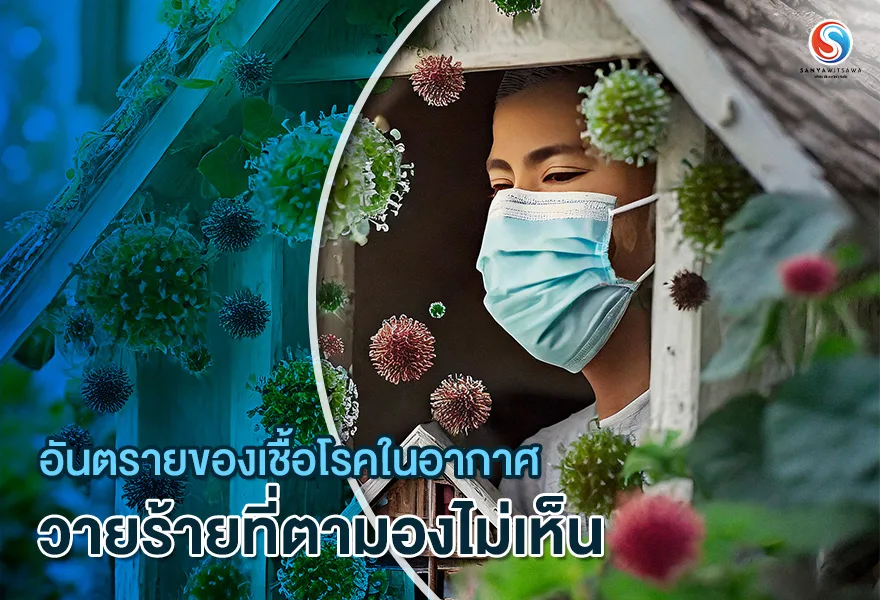
The Dangers of Airborne Germs: The Villain You Cannot See
Airborne germs are a silent threat that can seriously affect our health in many ways, particularly in areas with high air contamination from pollution and germs, such as Bangkok, Chiang Mai and other densely populated provinces. Coughing, sneezing or breathing on one another is a major route by which germs can spread through the air and be transmitted to other people.
The diseases most commonly transmitted through the air are typically respiratory-tract infections, such as the common cold, influenza, avian flu, SARS, pneumonia and tuberculosis. These can arise from infection anywhere in the respiratory tract, from the nose, throat and windpipe down to the lungs. Basic ways to prevent respiratory-tract infections include keeping your hands clean at all times, using a cloth or tissue to cover your mouth and nose when coughing or sneezing, and wearing a face mask.
Beyond this, air pollution is another factor that increases health risk. Air pollution is the contamination of indoor or outdoor air by gases and solid particles that alter the natural characteristics of the air. Important toxins harmful to health include fine particulate matter (PM 2.5 and PM 10), carbon monoxide (CO), ozone (O3), black carbon (BC), sulphur dioxide (SO2) and oxides of nitrogen (NOx). The health effects of fine particulate matter depend on the level of exposure and its duration, and may cause effects such as irritation of the eyes, nose and throat, coughing, wheezing and lower-respiratory-tract infections.
Protecting against and reducing the effects of air pollution and airborne germs can be done by monitoring the air-pollution levels in your own neighbourhood and following the advice of local authorities. Staying indoors as much as possible is important, especially for those at risk, such as children and the elderly, who should remain indoors as much as they can and stay away from heavily trafficked roads. In addition, keeping the inside of your home clean — mopping floors and wiping away dust with a damp cloth is recommended to reduce fine particulate matter floating in the air — together with installing a standard-compliant clean-air system to screen out contaminants invisible to the naked eye.

How Airborne Germs Spread
Airborne germs can spread in many ways. If you find this hard to picture, think back to the era of the COVID-19 virus outbreak, which is the clearest, most vivid example of airborne transmission. Airborne germs can spread in several ways, as follows:
1. Coughing, sneezing, talking or singing: When an infected person coughs, sneezes, talks or sings, germ-laden droplets are dispersed. These droplets can linger in the air and enter the respiratory tract of other people nearby.
2. Droplets and aerosol particles (Aerosols): There are three main forms. The droplets involved in germ transmission are large droplets, small droplets, and droplet nuclei or aerosols, which form when small droplets are blown about and dry out or break down rapidly.
3. Enclosed spaces with insufficient ventilation: In enclosed spaces without good ventilation, droplets and aerosol particles can accumulate and linger in the air for a long time, creating a higher risk of infection.
4. Contact with a patient's mucus or saliva: In addition to airborne transmission, germs can also spread through direct contact with a patient's mucus or saliva, or with objects and personal items contaminated by germs.
Preventing airborne infection can be done by reducing the dispersal of one's own droplets and reducing the droplets received from others. Preventive measures include arranging spaces with proper ventilation, avoiding gatherings in enclosed spaces, wearing a face mask, keeping a distance of at least 1–2 metres, washing hands with soap and water or alcohol gel of 70% concentration or higher, and cleaning various surfaces, all of which help further reduce the risk of airborne infection.
The importance of clean rooms in protecting against airborne germs
A clean room (Clean Room) is a space in which the quantity of various particles is controlled, including dust, germs, humidity, temperature and air pressure, so as not to exceed defined standard limits.
The importance of clean rooms has many dimensions, as follows:
Protection from airborne contaminants: A clean room lives up to its name: it helps protect against and control airborne contaminants, whether pollution, germs, mould, bacteria or outside air, keeping them from entering the room. This is extremely important in the manufacture of medicines and food, or in the care of patients whose bodies are especially sensitive to contaminants.
Controlling air pressure: A clean room can be designed to have negative or positive air pressure in order to keep germs or contaminants out from outside or in from inside the room.
Maintaining production standards: In industries that demand high cleanliness, such as pharmaceuticals, electronics or high-precision components, a clean room helps ensure that products meet the defined standards of quality and performance.
Controlling supplementary factors: In addition to controlling particles and dust, a clean room also controls supplementary factors such as air velocity, temperature and relative humidity, in order to create the right environment for production or experimentation.
Preventing the spread of germs: In hospitals, operating theatres or patient-care areas, a clean room helps prevent the spread of germs, making it possible to care for patients in a safe and clean environment.
Maintaining product quality: For industries with high cleanliness requirements, such as the semiconductor industry, a clean room helps ensure that the products manufactured are of high quality and free from defects that could arise from contaminants.
For these reasons, clean rooms are extremely important to both health and manufacturing industries.
Build a clean room to leading-hospital standards with Sanyawit
To meet this kind of need, Sanyawit offers end-to-end design, installation and consultancy services for air systems in homes, workplaces and hospitals. Our systems focus on managing air quality to create clean, safe air for homes, workplaces and places where patients need to recover.
With the operation of our clean-air equipment such as the HCU, together with the air circulator that filters good air into the building from the very first step by creating Positive Pressure so that stale air is pushed out through the various gaps in the home — keeping outdoor pollution from entering — which is a working principle that differs from an ordinary air purifier, you can be confident that the air inside your home will be of good quality, clean and truly safe from PM 2.5 dust as well as germs, bacteria and various viruses. It can turn an ordinary room into a clean room in the blink of an eye.
Sanyawit, a clean-air specialist, certified to Ministry of Public Health standards.
If you are interested in our services or would like a consultation, you can contact us at any time.