
Indoor Pollution Problems: Don't Let Them Linger; Tackle Them Before They Harm Your Health
Don't let indoor pollution problems linger; tackle them before they harm your health. Indoor air is at risk of becoming a reservoir of pollution up to 5 times worse than outdoor air, because most homes tend to be enclosed and poorly ventilated, lacking sufficiently effective air circulation. This leaves stale air and all kinds of impurities circulating within the home and accumulating in ever-greater quantities. Add to this the fact that most people spend an average of 90 percent of their time indoors, and we end up taking large amounts of those impurities into our bodies.
And of course, today, no matter where we are, pollution problems are unavoidable, whether inside the home or outside it, and that pollution is increasingly affecting our health. Basic preventive measures such as wearing an N95 mask can no longer fully address our health needs, because wearing a mask at all times, even at home or inside buildings, is rather impractical. We should therefore also look for ways to prevent and remedy the pollution around us.
In today's article, Sanyawit will take you through "how to tackle indoor pollution problems" in order to raise your quality of life and improve your health. Let's explore those approaches together.
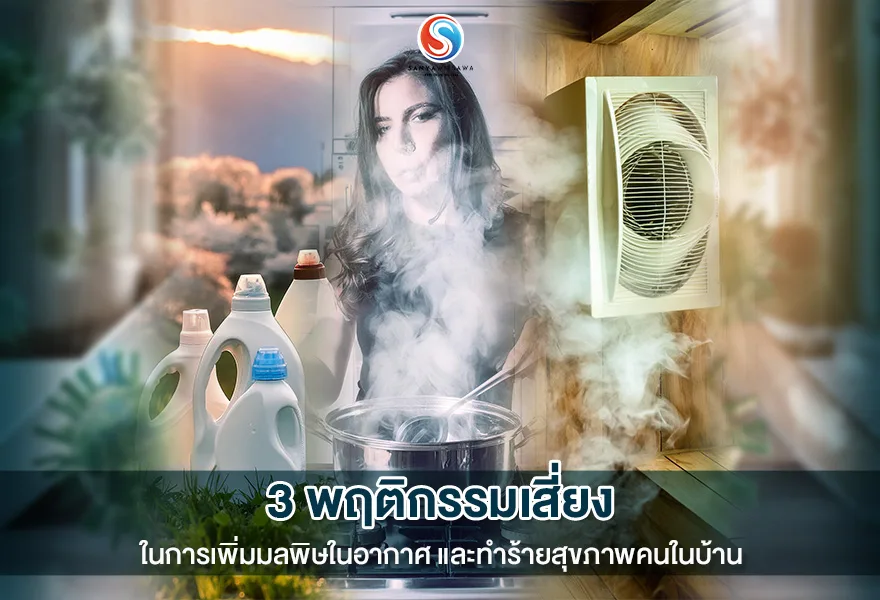
3 Risky Behaviors That Increase Air Pollution and Harm the Health of People at Home
But before we look at how to tackle indoor pollution, let's first look at which kinds of behaviors unknowingly increase air pollution in our home, because the best solution to a problem is to prevent it before it arises.
Cooking without proper ventilation
Failing to use an extractor fan or open a window while cooking can lead to a buildup of pollutants and oil mist, including carbon monoxide, nitrogen dioxide, and fine particles. When cooking, you should therefore turn on the extractor fan or open a window to help draw out and disperse pollutants and cooking odors so they do not accumulate inside the home.
Using cleaning products that contain volatile organic compounds (VOCs)
Most household cleaning products contain volatile organic compounds, or VOCs, such as ammonia, chlorine, and formaldehyde. These chemicals can be released into the air when the products are used, resulting in high levels of VOCs in indoor air. Prolonged exposure to VOCs can cause respiratory irritation, headaches, and other health problems. When choosing cleaning products, you should opt for cleaners that do not irritate the nose and skin, in the gentle or naturally derived category.
In addition, improper storage of chemicals or solvents can cause those chemicals to accumulate in the home, for example certain chemical cleaning products, paints, or insecticides. Such substances should be stored in a well-ventilated area or a dedicated storage cabinet, kept separate from everyday products and living areas, in order to reduce the chance of chemical evaporation in spaces used for daily living.
Insufficient ventilation in the home
Poor ventilation in the home can lead to a buildup of air pollutants greater than you might imagine. Without proper airflow, pollutants such as dust, pet dander, mold spores, and volatile chemicals can accumulate indoors over long periods and lead to respiratory problems, allergies, and many other health issues. The key to managing ventilation problems is to provide proper ventilation by opening windows, using extractor fans, and keeping living areas clean and consistently well-ventilated.
Now that we know the 3 risky behaviors that may increase indoor pollution, let's look further at the methods for tackling indoor pollution in our home, and whether each method can truly eliminate pollution.

How to Deal With Indoor Pollution Problems and Sustainably Improve Quality of Life and Health
Change the home environment so air is always circulating
Air circulation is a key factor in helping reduce indoor pollution. Even during periods of high PM2.5 dust, opening windows or vents to circulate the air remains essential to reducing the buildup of airborne pollution, although you must also consider the appropriate duration; windows should not be left open for too long. When opening windows, open at least 2 that are positioned opposite or diagonal to each other so the air has a way in and out. Ventilating with a fan also helps increase air movement within the room. And if you want to invest a little more, you can install a fresh-air supply system and an energy recovery system (Energy Recovery Ventilator: ERV) together with a dust filter to obtain even better air from outside.
Clean regularly to reduce the buildup of pollution in the home
Activities and items in the home can also cause a buildup of air pollution. So in addition to ventilation, regularly cleaning your belongings is something that should be done in parallel. When using cleaning agents, you should also choose ones without harsh chemicals. Furthermore, you must regularly clean your air conditioner on schedule and wash the filters routinely, and if you have an air purifier, you should likewise replace its filter on schedule.
Grow plants that help purify the air
Although plants are not as effective at purifying the air as an air purifier, they are another natural air-purifying aid and also provide other benefits, such as helping us feel relaxed and adding beauty to the home.
Regularly check outdoor and indoor air quality
Checking air quality regularly helps us stay aware of the air quality around us and helps us find ways to protect and remedy it according to the air quality at any given time, for example whether to open windows now, whether we can exercise outdoors, or whether we should exercise indoors. We can check outdoor air quality values from many websites and applications, such as https://www.iqair.com/th-en/thailand/bangkok, https://aqicn.org/city/bangkok
As for checking indoor air quality, if your air purifier already has a built-in sensor, you can read the air quality values from the color band, the display screen, or the air purifier's app. Alternatively, you can buy a dedicated indoor air quality sensor to measure it. The indoor air quality values that should be measured include PM2.5, PM10, TVOC, and CO₂ dust.
Choose an air purifier that genuinely addresses air quality
An air purifier is one of the key aids in managing various pollutants inside the home, especially during seasons with high levels of PM2.5 dust. Choosing a suitable air purifier requires considering various factors, from room size, Clean Air Delivery Rate (CADR), and air filtration technology to the performance of the air filter, which should be a HEPA H13 filter or higher to help filter PM2.5 dust, and should include an Activated Carbon filter to capture VOCs and various odors. There are also other factors that should be considered, such as noise, Smart Home connectivity, the presence of air-quality sensors, power consumption, warranty, and servicing. People with allergies should consider an air purifier certified by the Ministry of Public Health, and it should be an air purifier designed specifically for medical use, such as the HCU germ-control air purifier, which has long been used for clean rooms and sterile rooms in leading hospitals.
HCU by Sanyawit, the germ-control air purifier for better air quality in our home
The HCU by Sanyawit germ-control air purifier is an air purifier that strongly addresses indoor air quality, because the HCU can thoroughly and comprehensively filter pollution, PM2.5 dust, pathogens, bacteria, impurities, and the various fine particles mixed into the air. Because it is an air purifier fitted with a HEPA Filter of the standard used by leading hospitals, you can be confident that the air passing through the HCU air purifier will be clean, pure, and free of contaminants, guaranteed by our experience installing clean-air systems in leading hospitals, clinics, and healthcare facilities nationwide. We can say it addresses every clean-air need in a single unit.
In addition, our air purifier delivers a high airflow yet is quiet at just 50 decibels, so it does not disturb work or daily life and can be installed in a bedroom or a patient room without affecting rest. Every HCU unit has passed hospital clean-room standard testing by a third-party company, so you can be confident in its performance, filtering the air thoroughly clean so you can breathe deeply, free of contaminants once and for all.
These days, air purifiers vary in price, both cheap and expensive, but if you want a complete solution in a single unit that you won't need to replace often, choosing a high-performance air purifier is one way to save money in the long run. It also visibly improves our living conditions, and is certainly worth the value and the price, because investing in health is the best long-term investment.
When we keep the air quality inside our home consistently good, we begin to see impressive results. In addition to a reduction in respiratory problems, we may notice that we sleep better and feel refreshed when we wake up in the morning, no longer suffering nasal or respiratory irritation.
Fresh air can help reduce stress and add happiness to everyone in the home. Prioritizing clean indoor air is another way to create an environment that fosters love, happiness, and wellbeing, filling every day with energy and joy. These are key factors in genuinely raising quality of life.
"Don't leave it too late" and only then look for a solution, because solving a problem at its symptoms, or starting to do something once your health has already deteriorated and spiraled, is always harder than prevention from the very start.
Sanyawit designs and installs clean-air systems for residences to the standards of leading hospitals nationwide.
When you think of effective clean-air filtration delivered by a caring, highly experienced team, it has to be Sanyawit.
"Because your every breath is precious."
If you are interested in learning more or would like to use the clean-air system installation services of Sanyawit, you can contact us at any time.